
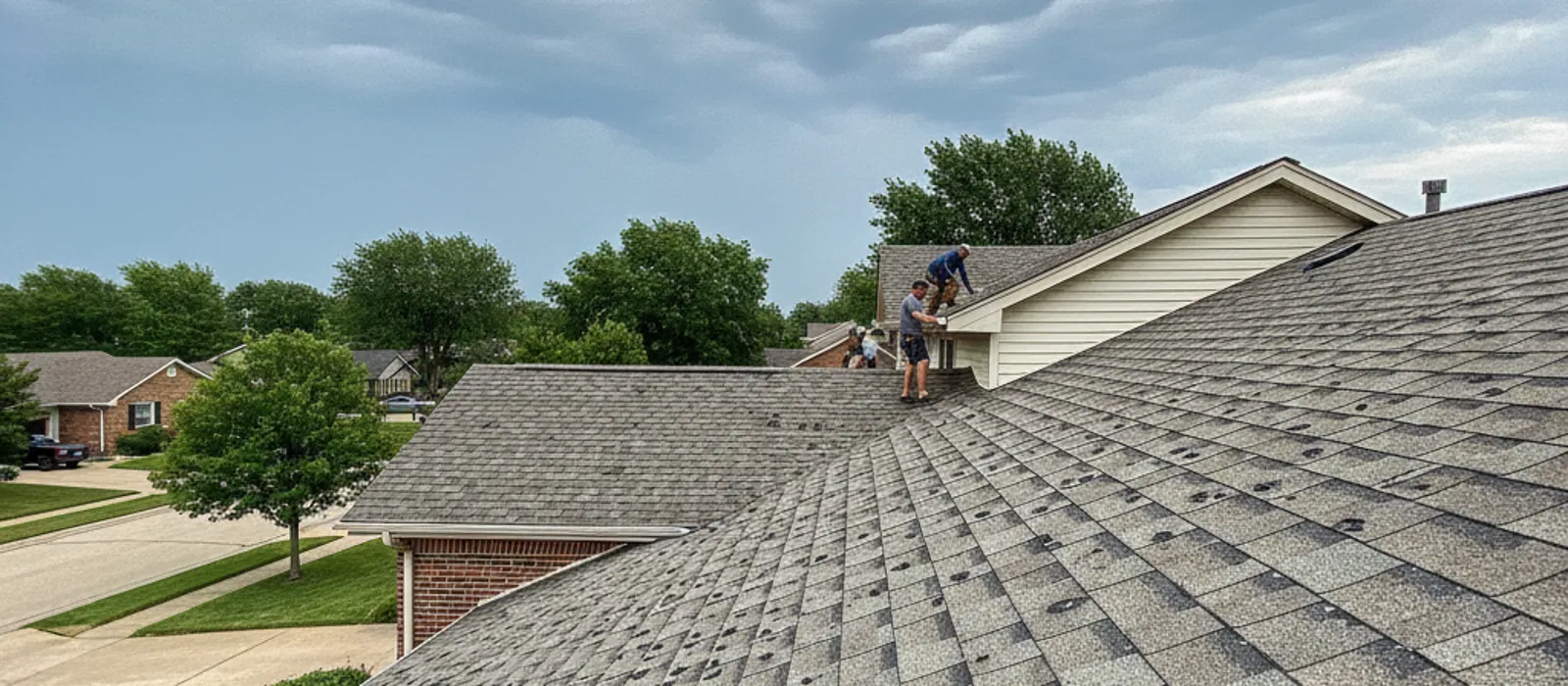
Hail Damage Is More Than a Dark Spot
Hail-damaged asphalt shingles may show localized impact-related changes, including disturbed surfacing or damage to the shingle beneath it. But a dark mark, loose granules, or a dent on a nearby vent does not by itself establish shingle damage. A reliable assessment considers the individual mark, the surrounding roof, other possible causes, and evidence of impacts around the property.
For a Wichita homeowner, the useful first action is safe documentation and a professional inspection, not climbing up to press suspected bruises. Request hail damage roof evaluation and ask for labeled photographs with explanations of what each image establishes.
IBHS’s identification guide distinguishes hail indicators from blisters, mechanical marks, and general weathering. It also treats collateral impact evidence separately from the roof-covering assessment. IBHS: Is It Hail Damage?. That distinction should guide how you read an inspection report.
Learn What the Inspector Means by a Bruise
A bruise is a term used during hail assessment for an impact-related condition in the shingle. IBHS notes that such conditions can involve a tactile observation. That does not make pressing roofing an appropriate homeowner test, and it does not mean every soft-feeling area has the same cause.
Ask the inspector to explain the observed condition without relying only on the word. Was a surface change visible? Was the underlying shingle affected? How was the location evaluated? The report should describe the basis of the conclusion in language you can understand.
A photograph may not capture every observation made during close inspection. That limitation makes the written explanation more important. A caption that simply says “bruise” without location or supporting description leaves a homeowner unable to compare findings or understand the proposed repair.
Use a Comparison Table as a Question List
| What appears in a photograph | What to ask the inspector | What not to assume |
|---|---|---|
| Localized dark patch | What distinguishes an impact from another cause? | Every dark spot is hail |
| Scattered granules | Is this new-roof shedding, wear, or localized damage? | Gutter granules prove a storm loss |
| Repeated similar marks | Were installation or mechanical causes considered? | A pattern alone settles causation |
| Blister-like surface condition | How was blistering distinguished from impact? | All circular marks are equivalent |
| Dents on metal nearby | What separate findings exist on the shingles? | Metal dents prove shingle failure |
| Mark highlighted with chalk | What did the inspector observe before marking? | A circle is evidence by itself |
| No visible ceiling leak | What is the shingle condition? | No interior water means no damage |
The table is not a self-diagnosis chart. It helps you request a better explanation and recognize when a report jumps from an observation to a conclusion without showing its reasoning.
Keep Granule Loss in Context
GAF explains that newly installed shingles can shed excess manufacturing granules and that persistent significant loss or other changes warrant attention. GAF granule-loss bulletin. That is one reason a handful of granules does not identify a storm cause.
Tell the inspector when the roof was installed and whether granules were noticed before the event. If the roof age is uncertain, state that clearly. The history helps the professional interpret an observation without assuming it is new.
Ask whether loss is localized at suspected impacts or described more generally across the roof. The answer should connect to photographs and the broader assessment. Do not sweep, scrape, or rub shingles to reveal an underlying surface for a photograph.
Distinguish Hail From Look-Alikes Carefully
A roof may have more than one condition. Weathering, installation-related marks, and suspected impact damage can coexist. A report should not force every visible feature into a single explanation just because the inspection followed a storm.
Ask what alternatives were considered for the marks used to support the recommendation. You are not asking the inspector to write a scientific paper; you are asking for enough explanation to understand why a mark matters.
For example, a hypothetical report shows a dark patch and labels it hail. A stronger report places that patch on the roof map, describes the observed condition, and explains why other causes are less consistent with the findings. The second report gives the homeowner something meaningful to review.
Read Collateral Evidence for What It Establishes
Dents or impact marks on other surfaces can help establish that hail occurred around a building. They do not automatically determine the condition of every shingle. Ask the inspector to keep those observations and roof findings separately labeled.
IBHS also distinguishes spatter from damage in its guide. A cleaned-looking mark on an exposed surface should not be treated as a structural defect simply because it is visible after a storm.
Photograph accessible collateral observations from safe ground locations without entering debris hazards. Include wider context so the item can be located later. Do not damage or alter a surface to make marks show more clearly, and do not retrieve roof-level evidence yourself.
Understand Why a Dry Ceiling Does Not End the Assessment
IBHS research discusses the relationship between hail-related shingle damage and water permeability, including differences associated with damage severity. It does not provide a homeowner visual threshold that can be applied to every roof. IBHS water-leakage research summary.
The practical implication is to evaluate the roof covering itself rather than waiting for an indoor leak to prove a concern. At the same time, do not predict that every suspected mark will cause immediate water entry. Both conclusions go beyond what a casual observation establishes.
If there is active interior water, report it as a separate priority. The inspector should investigate the entry path instead of assuming it comes from whichever hail mark is easiest to photograph. Roof penetrations and other details may also need evaluation.
Ask for a Roof Map, Not a Photo Pile
A useful report connects close-ups to specific slopes and components. Request overview images and location labels. Without them, multiple photographs may show the same small area while appearing to document the entire roof.
Ask which areas were inspected and which were inaccessible. If the report recommends work on several slopes, the findings should explain that scope. If only a limited area is affected, the repair discussion should identify its boundary.
Keep original photographs when available and retain the report’s captions. A folder of cropped images loses context. The map and description together make it easier for another professional to understand the assessment without repeating every observation from scratch.
Avoid Unsupported Hit-Count Rules
Do not assume there is one universal number of marks that automatically requires roof replacement. Ask what standard or decision process the inspector is using and how it relates to the material, observed damage, and proposed scope.
If a report includes counts, ask how areas were selected and what qualified as a counted condition. A number is useful only when the definition and location are clear. Otherwise, it can create an appearance of precision without helping the homeowner decide.
Keep insurance evaluation criteria separate from construction repairability. The work needed to restore a roof should be explained technically, while policy decisions belong to the insurer and the applicable contract. A contractor should not use an unexplained count to promise coverage.
Give Roof Age a Supporting Role
Age can inform the inspection, but it cannot identify the cause of an individual mark by itself. A newer roof can have damage, and an older roof can show wear unrelated to the most recent storm. Ask the report to distinguish those observations.
Provide installation records if available. If the roof was repaired in sections, mention that different areas may have different histories. A single age estimate for the house may not describe every slope.
A hypothetical home has a recently replaced garage roof and an older main roof. The inspector should not assume identical condition or repair options across both. The report should identify those differences and explain how they affect the recommendation.
Separate Identification From Repairability
Establishing a damaged shingle is one question. Determining how it can be repaired is another. Ask whether adjacent material can be retained and what components must be disturbed to perform the work.
Use roof repair planning for a localized scope and replacement planning when broader findings support that comparison. The recommendation should describe both the damage extent and the practical repair boundary.
A small number of visible conditions does not automatically make repair simple, and numerous cosmetic observations do not automatically justify replacement. Request the reasoning that connects the actual roof condition to the proposed construction work.
Review Product Ratings Without Treating Them as Guarantees
ARMA’s test-standards guide explains that wind and impact classifications evaluate different characteristics and that laboratory tests do not reproduce every field condition. ARMA product and test standards.
If your roof is described as impact resistant, identify the exact product and relevant documentation. Do not assume the label means hail cannot damage it. Also avoid assuming a lower classification proves that every mark is functional damage.
When choosing replacement materials, compare documented characteristics and actual project cost. Ask the insurer separately about any applicable policy treatment. A product rating is useful information, but it should not become an invented promise of coverage, discount, or indefinite service life.
Keep the Event Timeline Honest
Record when the storm occurred if known and when you first observed the condition. If no one saw the roof before the event, acknowledge that the exact time a mark appeared may be uncertain. That does not make the inspection pointless; it keeps the record accurate.
Retain relevant weather information as context, separate from property evidence. A broad hail report cannot establish the condition of a particular roof, and a contractor’s presence in the neighborhood is not a weather measurement.
If earlier photographs exist, share them with the inspector. They may help establish whether a visible condition is new. Do not edit old images to create a stronger comparison or present an approximate date as certain.
Ask Better Questions When Opinions Differ
Start by comparing what each inspector actually observed. Did both evaluate the same slope? Did one have closer access? Did the reports use the same definition of damage? Differences in scope or method can explain some disagreement.
Ask each professional to address the specific conflicting finding. A focused question about one location is more useful than asking whether the other company is wrong. Request a written explanation rather than relying on competing verbal assurances.
Consider a further qualified assessment when the disagreement would materially change a major purchase. The goal is to resolve the uncertainty with better evidence. Do not simply collect opinions until one matches the outcome you prefer.
Build a Decision File Before Approving Work
Keep the inspection report, roof map, original images, event timeline, and proposed scope together. Include any temporary-protection record and prior repairs. That file should make the recommendation understandable without the salesperson present.
Use the Wichita roof cost guide to organize budget questions after the scope is clear. Ask which items address documented damage and which are optional upgrades. Do not compare totals while the proposed areas or materials remain undefined.
A good decision file also records limitations. If concealed conditions will be checked only during repair, identify the change-order process. This lets you move forward with a defined plan while acknowledging what has not yet been observed.
Questions About Hail-Damage Photographs
Can I Diagnose Hail Damage From a Phone Picture?
A picture can show a concern, but it may not establish the cause or the condition beneath the surface. Use it to request inspection and explanation. A professional report should combine location, observation, and reasoning rather than treating the photograph as self-explanatory.
Should I Press a Suspected Bruise?
No. Leave close inspection to a professional using appropriate access and methods. Pressing or scraping material can change the condition and creates unnecessary risk if it requires roof access. Ask the inspector to describe their findings instead.
Are Dented Gutters Enough to Replace the Roof?
They are separate property observations. The shingles need their own assessment, and the repair scope must follow the roof findings. A gutter defect can justify gutter work without automatically establishing a whole-roof replacement need.
What If the Roof Looks Normal From the Street?
Ground views may not show smaller conditions. If there are reasons for concern, request professional evaluation and record the visibility limits. A normal distant appearance should not be described as a complete inspection.
What Makes an Inspection Report Credible?
It identifies locations, explains observed conditions, considers look-alikes, records limitations, and connects the proposed work to the findings. That structure helps a homeowner make a measured decision without exaggerating a storm’s effects or overlooking a real defect.
Preserve Image Context When Sharing a Report
Send the complete report or include both overview and close-up images when requesting another opinion. A cropped photograph can remove the roof location, adjacent material, and scale reference that supported the original interpretation. Keep annotations on copies while retaining the originals.
Ask the inspector whether a photograph was taken before or after any marking or authorized work. That sequence can matter when comparing reports from different dates. A clear image record does not need dramatic contrast adjustments or filters. It needs enough context for the next reviewer to understand what was photographed and what the original inspector concluded from it.