
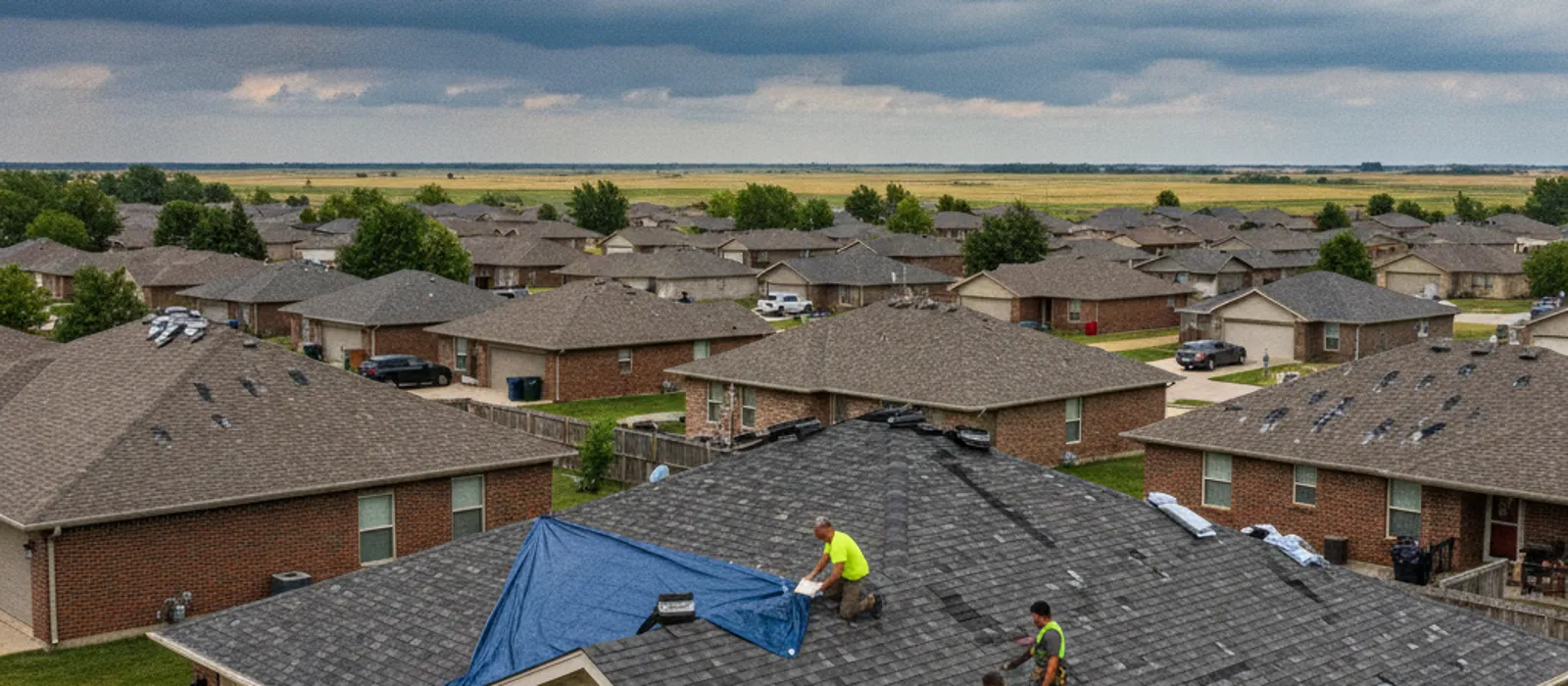
A Derby Storm Inspection Should Produce a Property-Specific Decision
After wind or hail in Derby, a roof inspection should document the condition of your roof, distinguish urgent openings from other observations, and explain whether repair, further evaluation, or no immediate work is recommended. It should not begin with the assumption that every nearby house needs replacement.
If water is entering, roofing is visibly displaced, or debris threatens an occupied area, report that when requesting service. Keep people away from hazards and leave roof access and temporary covering to trained professionals. For a local assessment, start with roofing services in Derby and provide the property address, event timing, and observed symptoms.
A useful report connects photographs to roof locations and separates observations from conclusions about cause. That record supports practical repair planning. It does not guarantee insurance coverage or establish that a particular storm damaged every component shown in a photograph.
Decide Whether the First Call Is for Protection or Inspection
An active leak and a concern about possible hail marks require different immediate responses. Describe which situation you have. A provider may need to arrange temporary protection before completing a broader assessment.
From a safe ground location, note missing roofing, hanging materials, or a fallen branch. Do not approach damaged power lines, unstable trees, or loose material to obtain a closer image. If an immediate public-safety hazard exists, contact the appropriate emergency service or utility.
Inside, avoid a sagging ceiling and water near electrical equipment. Do not enter an unsafe attic to find the source. Tell the service provider about these conditions so the response can be coordinated.
If there is no urgent symptom, schedule a documented inspection and gather records. Lack of visible leakage does not prove the roof is undamaged, but it also does not justify skipping the evidence and ordering replacement.
Gather a Short, Accurate Event Record
Write down the date and approximate time of the weather you observed. Keep separate notes for what you personally saw and what you learned from a report or neighbor. This prevents an uncertain event history from becoming a false statement about the property.
Save safe photographs of visible changes, including the room or exterior area where they occurred. A wider view helps locate the concern, while a detail image can show the condition. Do not alter the roof or press suspected marks to make them easier to photograph.
Collect earlier inspection reports, listing photographs, installation invoices, and repair records. They may help establish whether a visible condition predates the event, although a distant older photograph may not resolve small details.
The NWS Wichita account of April 25, 2026 documents a regional hail event affecting Wichita. It should not be used as proof of a strike or damage at a Derby address. Ask any assessor to distinguish regional weather context from evidence on your property.
Define the Inspection’s Coverage Before the Visit
Ask which roof sections, penetrations, flashings, and accessible interior areas will be assessed. Identify attached garages, porches, and detached structures separately if you want them included. An inspection of the house does not automatically cover every building on the lot.
Clarify the access method and limitations. A ground or aerial review may be useful, but the report should not imply that concealed materials or every close detail were examined. The method should fit the question being answered.
Ask whether the inspection includes a written report and photographs, and whether there is a fee. Knowing the deliverable helps you compare services beyond the phrase free inspection.
Do not authorize repairs merely by requesting an assessment unless that is clearly your intent. Keep the initial scope understandable: inspect, document, recommend, and identify any immediate protective need.
Use an Inspection Checklist That Leads to Decisions
| Report item | What the homeowner should receive | Decision it supports |
|---|---|---|
| Roof layout | Labeled slopes and included structures | Confirms what was assessed |
| Urgent conditions | Location and protection recommendation | Prioritizes immediate action |
| Shingle or panel findings | Context and detail photographs | Evaluates repair need |
| Flashings and penetrations | Specific component observations | Avoids focusing only on roof fields |
| Supporting exterior evidence | Clearly identified location and condition | Adds context without replacing roof evidence |
| Access limitations | Areas or layers not evaluated | Defines uncertainty |
| Recommended scope | Repair, follow-up, or replacement reasoning | Makes the next step reviewable |
Use the checklist to request a complete report, not to perform rooftop inspection yourself. A homeowner can review whether the information is present without needing to climb or test materials.
Ask the contractor to distinguish confirmed defects from observations that require further investigation. That distinction is especially helpful when a storm inspection reveals older maintenance issues alongside possible event-related damage.
Interpret Hail Evidence Carefully
Owens Corning’s hail damage technical bulletin notes that hail effects can vary within a neighborhood and may not be immediately apparent. Another home’s condition cannot determine yours.
Ask what specific roof findings support an impact interpretation. Dents on other surfaces may provide context, but the report should still explain what happened to the roofing itself. A photograph of a gutter is not a complete shingle assessment.
Likewise, missing granules or a dark circular area should be described and evaluated rather than automatically labeled hail. Roof age, earlier condition, and other possible surface mechanisms can matter.
If the inspector finds different conditions, request separate categories. A roof can have weather effects, installation concerns, and ordinary deterioration in different places. Repair planning becomes clearer when those observations are not collapsed into one label.
Include Wind and Water-Entry Details
Ask the assessment to cover displaced materials, vulnerable edges, and the connections around roof interruptions where relevant. A storm review limited to photographs of the broad roof surface can miss the detail that explains an active leak.
GAF’s roof damage guidance includes damaged shingles, open joints, and flashing concerns among inspection observations. Use that as a reason to request a broad condition review, not as a remote diagnosis.
Describe whether water appeared during the storm or later. If the leak is near a wall or penetration, ask how the exterior finding relates to the indoor location. The nearest visible feature is not automatically the entry point.
When a temporary repair is performed, request its location and limits in writing. It may protect one opening while the rest of the roof remains to be assessed. Keep that distinction visible in the invoice and follow-up plan.
Do Not Let Nearby Roof Work Decide Your Scope
Visible replacement activity can create pressure to act quickly. Ask what evidence on your roof supports the proposed work. A contractor should be able to explain the recommendation without relying on how many neighbors are replacing roofs.
Your roof may differ in age, product, installation, exposure, and prior condition. Even adjacent homes can require different responses. The comparison becomes useful only when those differences and the actual findings are considered.
A hypothetical homeowner may see several nearby replacement crews yet receive a report recommending a small flashing repair. Another may have no interior stain but documented roof damage requiring more work. Both examples show why the report should be property-specific.
Avoid signing a broad replacement agreement solely to obtain an inspection result. Read what you are authorizing and keep assessment, repair scope, and payment terms clear. The practical goal is an informed decision about your roof.
Know Derby’s Local Roofing Process
The City of Derby publishes a permit and licensing application page that includes roofing permits. Use the city as the starting point for a Derby property rather than assume Wichita’s process applies automatically.
Ask the contractor to confirm requirements for the exact address and scope, especially if an inspection leads to reroofing. Determine who obtains any required permit and supplies the completion records.
The city’s roofing application and related instructions may identify documentation expectations. Have the contractor use the current city materials and confirm any unclear requirement directly. Do not rely on a rule remembered from a different project or municipality.
An inspection report and a permit record serve different purposes. The report describes condition; administrative documents address the authorized work and local process. Keep both when they apply, along with the final repair scope.
Compare Repair and Replacement by the Findings
A repair recommendation should identify the affected area, method, and condition of surrounding materials. Ask whether compatible material is available and whether the repair can be completed without creating additional damage.
A replacement recommendation should explain the extent of defects or repairability concerns. Ask which roof sections are included and whether there are non-storm issues influencing the recommendation. That does not invalidate replacement, but it should be disclosed.
If the scope is uncertain, request the next investigative step. An unexplained jump from possible damage to whole-roof replacement does not give the homeowner enough information to evaluate the decision.
Review roof replacement cost factors when comparing larger work. Use an actual property estimate and separate optional upgrades from necessary restoration. This makes the financial decision clearer without inventing local market prices.
Keep Insurance Communications Factual
If you contact an insurer, provide accurate dates, observations, and documents. Do not state that damage is covered merely because a roofer identified a physical defect. Coverage depends on the policy and claim evaluation.
Ask the insurer what information it needs and how it wants urgent protection documented. Keep temporary invoices, photographs, and communications organized. Do not assume that a repair estimate is the same as an insurer’s settlement decision.
The roofer can explain construction findings and the proposed work. The owner should remain involved in communications and understand what has been submitted. Avoid signing documents that leave the repair obligation or payment arrangement unclear.
For physical storm assessment, use hail and storm roof repair services. Keep that request focused on documenting the roof rather than promising a particular claim outcome.
Handle Conflicting Reports With a Focused Follow-Up
If two assessments disagree, compare whether they inspected the same areas with similar access. One may have reviewed only the visible front slope while another evaluated the full accessible roof. That difference should be resolved before comparing conclusions.
Ask each inspector to identify the photographs and observations supporting its opinion. A useful disagreement can be narrowed to specific locations or interpretations instead of becoming a contest of confidence.
Request an independent assessment when the unresolved issue materially affects the decision. Provide the full reports and original images, not only the conclusion you prefer. The goal is to clarify the evidence.
Keep urgent protection moving while the broader dispute is reviewed. An active opening should not remain unattended simply because the parties disagree about whether other shingles were damaged by hail.
Review the Completed Work Against the Report
After repair, ask for photographs and an invoice that identify the work location and components. Compare them with the original findings and approved changes. Each repair item should have a clear completion record.
If replacement occurs, retain the installed product information and any applicable permit or warranty documents. Those records become the baseline for future maintenance and storm comparisons.
Observe previously affected interior areas during later rain from a safe location. Report new wetness or recurring symptoms promptly, with dates and photographs. A roof repair does not automatically restore wet insulation or finishes, so coordinate any remaining interior work.
Keep the full event file even when no immediate repair is recommended. A dated, documented inspection can be useful context for future changes, provided its access limits and conclusions remain accurately described.
Frequently Asked Questions
Should I inspect the roof myself after a Derby storm?
Limit your observations to safe indoor and ground locations. Roof access, testing, and temporary covering should be handled by trained professionals, especially after wind, rain, or impact damage.
Does a neighbor’s approved roof claim prove mine is damaged?
No. Their roof condition and policy decision do not establish yours. Request evidence tied to your own roof and keep construction findings separate from coverage decisions.
What if the report finds no immediate repair need?
Ask for the inspected areas, limitations, and any specific follow-up recommendation. Preserve the report and photographs so later observations can be compared with a documented baseline.
What should a Derby homeowner receive before authorizing work?
A clear scope, supporting findings, price and change process, schedule assumptions, and confirmation of applicable local requirements. Those details make the proposed work understandable before the first material is removed.
Keep the House and Outbuildings Separately Identified
If the property includes a detached garage, shed, or covered patio, ask whether each structure is part of the inspection. Give every building a clear name in photographs and estimates. A finding on an outbuilding should not be described as damage to the house roof, and work on the house should not imply that all structures were repaired.
This distinction matters when different coverings or installation dates are involved. Request a separate recommendation for each included structure and note any that were excluded. A single property address can still represent several different roofing decisions. Keeping those decisions visible makes the report easier to use when comparing estimates or discussing the work later.