
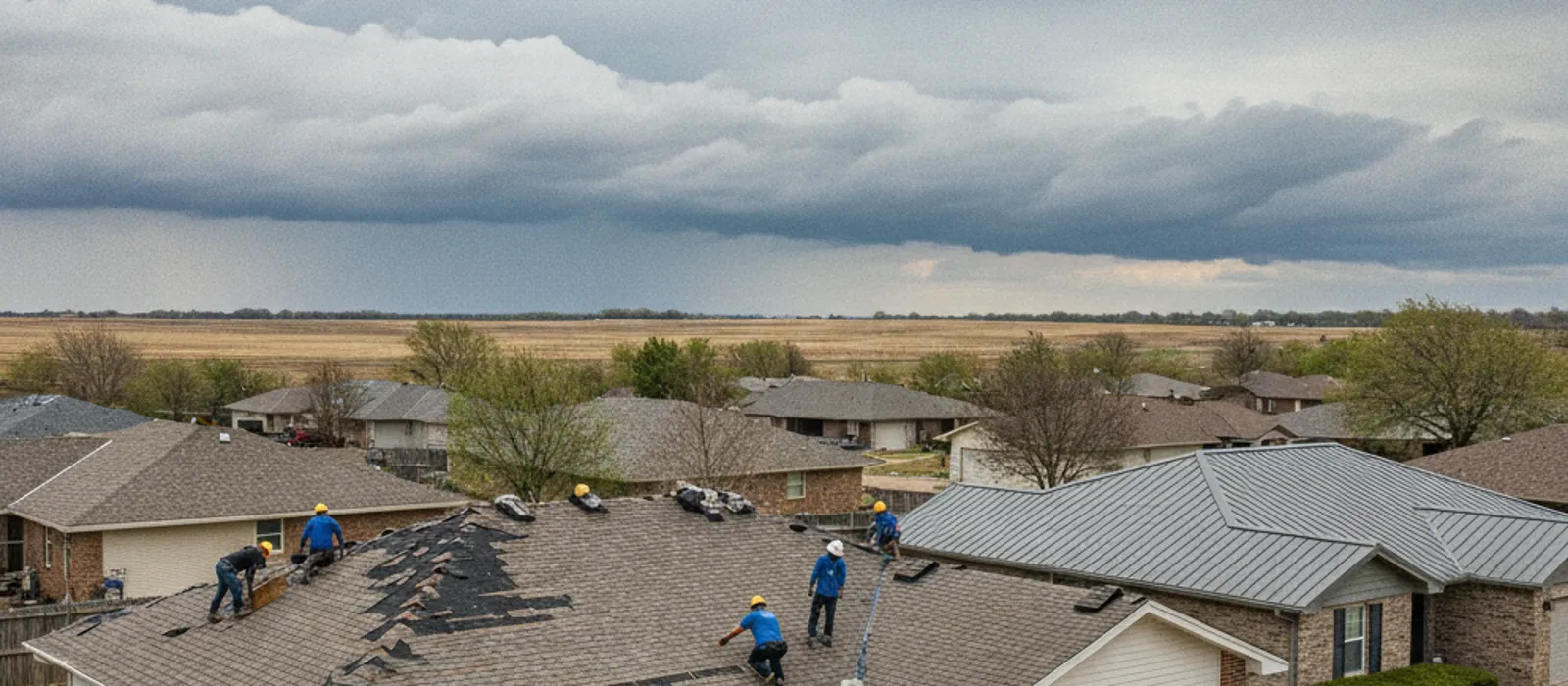
Tear-Off Provides More Visibility; Overlay Requires Proven Suitability
A tear-off removes the existing covering so the contractor can inspect and prepare the roof deck before installing the new system. An overlay, also called a recover, adds a new covering over the existing roof. Overlay may reduce immediate removal and disposal work, but it should be considered only after the existing assembly, product instructions, and local requirements have been evaluated.
For a Wichita homeowner with leaks, uncertain layers, distorted roofing, or an unclear repair history, request a tear-off proposal and an explanation of any suggested alternative. An overlay is not simply the same new roof with one unnecessary task removed.
Use Wichita roof replacement to discuss the actual assembly and the replacement cost guide to compare complete scopes. The decision should state what is being retained, why it is suitable, and what limitations the homeowner accepts.
Define the Words Before Comparing Estimates
Reroofing can refer broadly to replacement or recover work. A proposal that says reroof house may therefore be unclear about whether old material comes off. Ask the contractor to state the removal depth and retained layers explicitly.
ARMA distinguishes replacement from recover and calls for roof-specific evaluation, including the existing structure, deck, and covering. See its replacement-versus-recover bulletin.
Ask whether the scope includes removal of underlayment as well as shingles and how adhered materials will be handled. Do not assume every tear-off exposes the substrate in exactly the same way without reading the proposal.
Likewise, ask whether an overlay includes localized removal at details. A recover project may still require work at ridges, flashing, and transitions. The word overlay should not conceal those tasks or imply that nothing beneath the new field material needs attention.
Establish What Is Already on the House
Request an inspection of the existing layer count and material types. A visual impression from the street is not a reliable substitute. Different additions or repaired sections may have different assemblies.
Ask how the layer count was determined and whether any areas remain uncertain. The report should identify the location of observations rather than assume the entire house matches one accessible edge.
Gather prior invoices and photographs if available. An old document saying new roof may refer to an overlay, a partial replacement, or a full tear-off. Ask the inspector to reconcile the records with current observations.
Do not cut into the roof yourself to settle the question. If a limited opening is necessary, the contractor should explain the method, protection, and restoration before proceeding. The information should be obtained without creating an unmanaged leak risk.
Compare the Two Approaches Directly
| Decision point | Tear-off proposal | Overlay proposal |
|---|---|---|
| Existing covering | Removed to the stated depth | Retained as specifically identified |
| Deck visibility | Greater opportunity for direct review | Concealed conditions remain more limited |
| Disposal | Removal and hauling included | Less immediate removal, with retained material documented |
| Flashing | New or assessed reuse stated individually | Integration with the retained assembly must be explained |
| Product eligibility | New-system application documented | Recover application specifically confirmed |
| Appearance | New substrate preparation can be addressed | Existing surface suitability needs review |
| Future work | Current layers removed | Later removal includes retained and added material |
This table does not establish that overlay is always wrong. It identifies the additional questions that make an overlay decision reviewable.
If one proposal is materially cheaper, use the rows to understand what was omitted or deferred. A lower price is meaningful only when the homeowner understands the work and uncertainty behind it.
Ask What the Deck Evaluation Can Actually Establish
A roof deck supports the covering and its attachment. Ask the contractor what can be assessed before removal and what remains concealed. An attic inspection may provide useful information without revealing every part of the top surface.
For an overlay, request a written basis for concluding that the retained assembly is suitable. If the conclusion depends mainly on the absence of an interior leak, ask what other evidence was considered.
For a tear-off, ask how exposed decking will be documented and how necessary repairs will be authorized. Greater visibility is useful only if there is a process for acting on the findings.
A hypothetical homeowner may prefer tear-off because previous leak repairs are poorly documented. That preference is about resolving uncertainty, not a claim that hidden damage certainly exists. Keep the distinction clear when discussing the estimate.
Do Not Cover an Unresolved Leak Without a Diagnosis
An overlay should not substitute for identifying why the existing roof leaks. Ask where water enters and how the proposed assembly corrects that path.
PNNL’s existing-roof flashing guidance emphasizes integrating flashing with the roof’s water-control layers. That makes penetrations and adjoining details central to a recover discussion.
If the contractor proposes retaining a leaking detail, ask for the exact corrective work. More shingles over the field do not explain how a chimney, pipe, or wall connection will function.
When the source remains uncertain, request a roof repair investigation before choosing the permanent scope. The investigation may support replacement, but the eventual proposal should still address the cause rather than only the visible covering.
Confirm Product Instructions for the Actual Recover Assembly
Ask for the selected shingle manufacturer’s recover instructions, including any restrictions on the existing covering. A statement that roofers do overlays is not product-specific approval.
GAF’s ICC-ES evaluation report ESR-1475 includes a reroofing section with conditions for existing coverings, fastening, and details. It demonstrates that recover applications are conditional, not interchangeable with every new-roof installation.
You do not need to interpret the report alone. Ask the contractor to identify the provisions relevant to the proposed product and existing roof. Save the referenced version with the estimate.
If a contractor cannot identify the existing material or applicable instructions, that uncertainty matters. Resolve it before ordering rather than relying on a broad assurance that the new product can go over anything.
Treat Impact Claims as Assembly-Specific
ARMA notes that installing new asphalt shingles over existing shingles can affect impact-resistance ratings. Therefore, ask whether the impact documentation being presented applies to the proposed recover installation.
This is particularly relevant when a homeowner is paying extra for an impact-resistant product. The upgrade should be supported for the assembly actually being purchased, not just the shingle on a sample board.
Ask the manufacturer for clarification if the documents are unclear. Keep any response with the project records. Do not assume that a class label remains unchanged under every substrate condition.
If an insurance benefit is part of your decision, confirm the exact product and assembly with the insurer. The contractor’s material choice does not establish policy eligibility, and this article does not promise a discount or coverage.
Review Flashing One Location at a Time
An estimate should identify treatment at chimneys, walls, valleys, vents, and roof edges. A single line saying flashing as needed may leave the most consequential details undefined.
Ask which pieces will be replaced, which will be retained after inspection, and how the new covering connects to them. For an overlay, ask whether the added thickness changes any transition or clearance that needs attention.
For a tear-off, ask what happens if removal damages a component initially intended for reuse. The contract should contain a practical change process rather than leave the homeowner to decide under time pressure.
Request photographs of the completed details. Those images are useful for later maintenance and can confirm that the documented scope was addressed without requiring the homeowner to climb onto the roof.
Verify Local Requirements by Address
Do not rely on a national article to determine how many layers are permitted at a Wichita-area property. The applicable authority and project details need confirmation.
MABCD lists roofing among its trade permits on the Sedgwick County permits page. Ask who will verify jurisdiction, obtain any required permit, and coordinate applicable inspections.
A county mailing address does not necessarily answer every jurisdiction question. Have the contractor identify the authority for your property rather than assuming a neighboring community uses the same process.
Keep the permit responsibility in writing. Product instructions, industry guidance, and local requirements each have a role; one does not automatically replace the others. A recover proposal should demonstrate that those questions have been considered together.
Compare Present Savings With Deferred Work
An overlay can avoid some immediate tear-off and disposal tasks, but retained material still exists. Ask how that affects future removal and any later investigation or repair.
Do not claim that overlay always cuts lifespan in half or saves a fixed percentage. Those sweeping figures are not a substitute for the actual roof condition and written proposals.
Instead, compare the present price difference with the specific tasks omitted. Identify whether the savings come from removal, disposal, substrate preparation, or another scope change. Then decide whether retaining those conditions is acceptable.
A homeowner planning to sell soon should still document the assembly accurately. Short ownership does not eliminate the need for a suitable installation, and the record should not describe a recover project as a full tear-off replacement.
Use a Hypothetical Budget Comparison
Suppose a hypothetical tear-off proposal is $3,000 higher than a recover proposal for the same covering. That difference is illustrative, not a Wichita market estimate. Ask the contractor to explain the removal, hauling, preparation, and inspection opportunity included in it.
If the recover option also omits flashing work, the proposals do not yet isolate the cost of tear-off. Request a revised comparison with the same detail scope wherever feasible.
Consider your contingency separately. A tear-off may reveal repair needs that change the final cost, so ask for unit prices and approval procedures. An overlay may leave more concealed uncertainty, which should be acknowledged rather than priced as though it does not exist.
The useful financial question is whether the lower initial scope meets your requirements. It is not whether one can invent a future lifespan that makes the preferred option appear mathematically inevitable.
Plan for Concealed-Condition Decisions
Before work starts, agree on how the contractor will document unexpected decking or related damage. Request photographs, quantities, unit prices where appropriate, and a named person authorized to approve changes.
If an overlay is proposed, ask what finding would cause the contractor to stop and recommend tear-off instead. This contingency should be discussed before materials are staged.
For a tear-off, ask how the exposed roof will be protected while decisions are made. The contractor should plan removal and weather protection around the actual project and forecast.
Make yourself or an authorized representative reachable during the relevant phase. A clear process can prevent a rushed phone call from becoming the first time you learn that additional work may be necessary.
Consider Appearance Without Confusing It With Performance
Ask how the retained surface will affect the finished appearance of an overlay. Review the condition of the existing roofing and the selected product’s requirements rather than assuming that a new color hides every irregularity.
A tear-off can allow preparation of an uneven substrate, but it does not guarantee perfect visual uniformity without addressing the underlying cause. Ask what preparation is included.
Look at the roof from the elevations where appearance matters most. A visible front slope may influence your preferences differently from a rear utility area. Explain those priorities before selecting the covering.
Keep cosmetic concerns separate from functional suitability. A homeowner can reasonably prefer the appearance of one approach, but that preference should not be presented as evidence that the other is automatically unsafe or defective.
Distinguish Asphalt Overlay From Metal Recover
A metal roof installed over an existing roof is a different system decision from adding asphalt shingles over asphalt. Do not transfer eligibility assumptions from one to the other.
If considering metal roofing in Wichita, request the specific manufacturer’s recover design and an evaluation of the existing house. The proposal should identify substrate preparation, attachment, moisture considerations, and transitions.
A general statement that metal is light does not answer whether the retained assembly is suitable. Nor does a successful recover system on another building establish suitability for your property.
Compare that option as its own complete proposal. The homeowner should understand what remains, what is added, and how the system is documented, just as with any other roof replacement decision.
Finish With an Explicit Acceptance Decision
Before approving overlay, confirm that the existing layers are identified, the deck and structure have been evaluated appropriately, product eligibility is documented, local requirements are checked, and leak-related details are resolved.
Before approving tear-off, confirm the removal depth, disposal, decking contingency, flashing scope, weather-protection plan, and closeout documentation. Tear-off offers an opportunity to address the substrate, but the written scope makes that opportunity actionable.
If significant uncertainty remains about a recover proposal, ask what further inspection would resolve it. A lower initial price should not require you to accept an unexplained assembly.
Choose the approach whose retained conditions and new work you understand. For many homeowners, the visibility gained through tear-off is valuable; for an eligible recover project, the decision still needs a documented basis specific to the roof.