
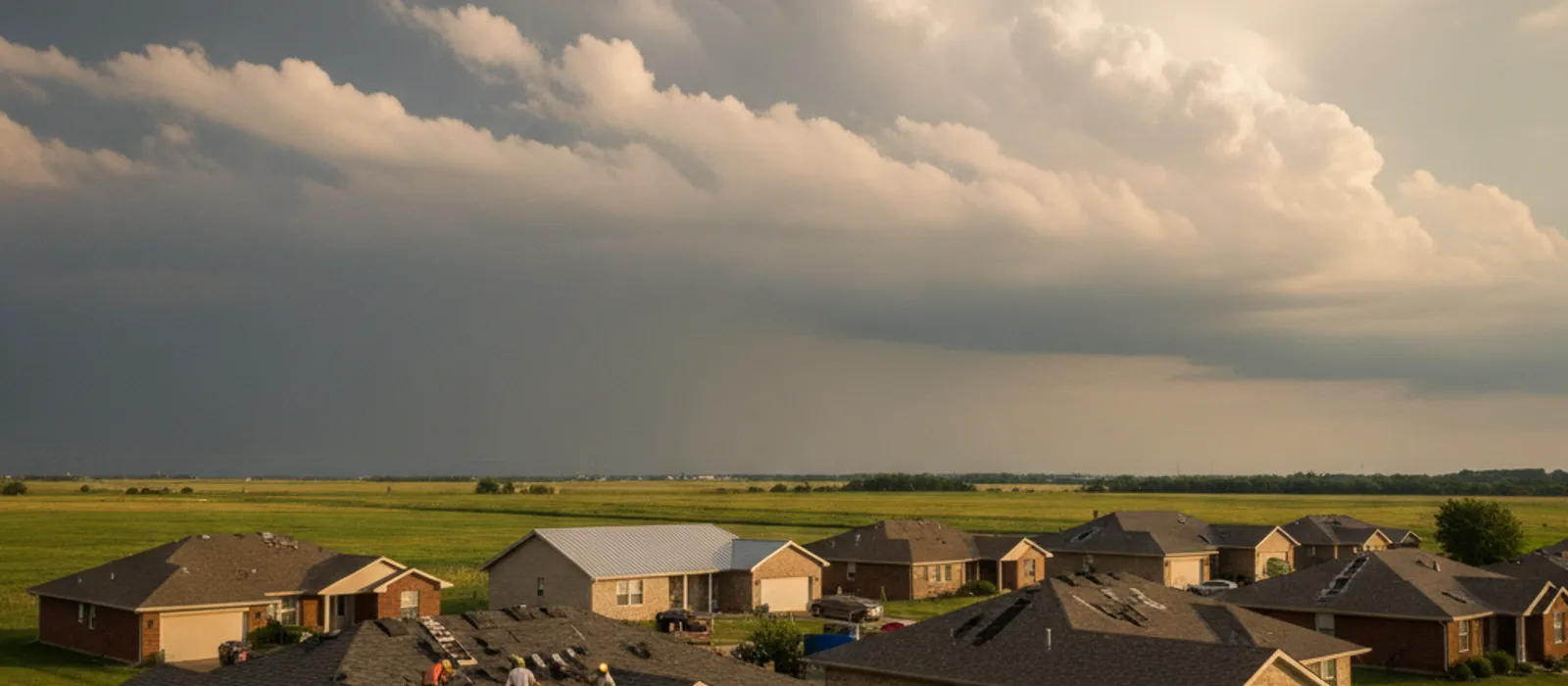
Repair When the Problem Is Limited; Compare Replacement When It Is Systemic
Roof repair is usually the first option to evaluate when the defect is identifiable, limited, and surrounded by material that can support a sound repair. Replacement deserves a serious comparison when deterioration or damage is widespread, reliable repair is difficult, or several unresolved roof-system problems would remain afterward.
Age, a ceiling stain, or one photograph does not decide the question alone. Ask for the location and extent of defects, the proposed repair boundary, and the condition of the roof that would remain. A useful recommendation explains why the chosen scope fits the house.
Start with Wichita roof repair for diagnosis and a defined repair option. When the findings justify a broader project, compare roof replacement on the same documented conditions. The goal is a decision supported by evidence, not a reflex toward the smaller or larger invoice.
Begin With the Actual Failure, Not the Preferred Solution
Describe the problem as you observed it: a stain appeared, a shingle is missing, a metal edge moved, or a leak returned after prior work. Then ask what caused it. This order prevents the estimate from becoming a material sales conversation before the defect is understood.
Ask whether the water source has been confirmed or is still suspected. A proposal can reasonably include investigation, but that should be stated. You should know whether you are paying to diagnose a problem or to correct one already identified.
PNNL explains that roof penetrations interrupt the water-control layer and need integrated flashing. Its existing-roof penetration guidance supports reviewing those details during reroofing and renovation.
For the homeowner, the practical question is whether the proposed work corrects the relevant connection. Replacing surrounding shingles without addressing a defective penetration detail may not answer the original concern.
Map the Distribution of Defects
Request a roof diagram or labeled overview photographs. Mark the locations of leaks, missing material, visible deterioration, and previous repairs. Distribution is central to the repair-versus-replacement decision.
One repeated leak at a rear wall suggests a focused investigation of that area. Several unrelated problems across different slopes call for a broader review. Neither pattern should be reduced to a simple count without examining the causes.
Ask whether the inspector reviewed the unaffected-looking sections. A replacement recommendation based on one closeup leaves the condition of the rest of the roof unclear. A repair recommendation should likewise acknowledge relevant defects outside the immediate work area.
Record inaccessible sections. A professional may need another visit or method to evaluate them safely. The appropriate response is to identify that uncertainty and its importance, not assume that unseen areas are either sound or damaged.
Use a Decision Matrix
| Finding | Repair discussion | Replacement discussion |
|---|---|---|
| One confirmed flashing defect | Strong candidate for a defined detail repair | Consider only if broader condition supports it |
| Limited missing shingles | Evaluate surrounding material and product compatibility | Consider if repairability or distribution changes the scope |
| Repeated leak at the same location | Reassess cause before repeating the patch | Include correction of the cause in any replacement |
| Widespread deterioration | Ask whether repairs would leave extensive unresolved wear | Obtain a complete scope and evidence |
| Several roof sections of different ages | Evaluate each section and its connections | Consider coordination benefits and remaining-life differences |
| Structural or concealed damage suspected | Define investigation and stabilization | Do not assume new covering alone addresses structure |
This matrix is a framework for questions, not an inspection standard. It helps separate localized defects from roof-wide concerns while leaving room for conditions that require more investigation.
Ask the estimator to identify the row that best describes your roof and explain any exceptions. A clear answer should reference locations and photographs, not just the age printed on a disclosure form.
Understand Repairability as a Separate Issue
A defect can be small while the repair is difficult. The surrounding roofing may need to be disturbed to replace a shingle or integrate flashing. Ask whether those adjoining materials can be worked without expanding the damage.
The contractor should explain the intended repair boundary and what could cause it to expand. That might include concealed decking deterioration or a material condition discovered during removal. Agree on how additional work will be documented and approved.
Do not perform your own flexibility test by lifting or bending shingles. Roof access and manipulation belong with qualified professionals using appropriate methods. Homeowner testing can introduce damage and confuse the original assessment.
Also ask about product compatibility and appearance. An available replacement may be functionally suitable but visibly different. Keep that cosmetic choice separate from whether the repair can provide a sound weather-shedding result.
Look at the Roof Details That a Replacement Would Retain
A replacement proposal is not automatically comprehensive. Ask which flashing, vents, and other components will be new and which will remain. Existing details can affect the value of the project.
GAF’s metal-flashing reuse bulletin recommends replacement where possible and allows reuse only under assessed conditions. That guidance illustrates why “reuse flashing” needs an explanation specific to the material’s condition.
If a contractor proposes retaining a detail associated with the current leak, ask how the underlying problem will be corrected. A new field of shingles should not make that question disappear.
Request photographs of concealed details when they become accessible. Replacement can create an opportunity to address them, but the contract must identify how that work is handled rather than assuming it happens automatically.
Compare Future Usefulness, Not Just Today’s Price
A repair has value when it resolves a defined problem and leaves a roof the homeowner can reasonably continue using. Replacement has value when it addresses broader conditions that a limited repair would leave unresolved.
Ask each proposal to state its limitations. A repair may leave older roofing in place and require future monitoring. Replacement may still exclude masonry, siding, interior drying, or other related work. You need those boundaries to compare the options.
Avoid a universal rule that repair is wrong once it reaches a fixed percentage of replacement cost. The useful life of the proposed repair, uncertainty, and household circumstances matter.
The Wichita replacement cost guide can help organize complete project costs. Use actual written estimates for your roof rather than inventing a market price to make one alternative seem obvious.
Use Hypothetical Arithmetic Transparently
Suppose, as a hypothetical example, a confirmed localized repair costs $1,200 and a complete replacement proposal costs $16,000. Those figures alone do not prove which option is better. The unanswered question is what condition remains after the repair.
If the rest of the roof is documented as serviceable, the smaller scope may preserve useful value. If extensive deterioration remains and further repairs are expected soon, the same repair may offer limited practical benefit.
Do not divide replacement cost by an assumed number of years and call the result a guaranteed annual cost. Future service life and maintenance are uncertain. Financial calculations should show assumptions rather than hide them.
A household can compare immediate cash needs, financing costs if relevant, and a contingency for unknown conditions. That is a more honest decision process than claiming a repair will definitely buy a particular number of years.
Give Roof Age the Right Weight
Verified age helps frame the inspection, but it cannot replace it. Ask whether the roof was fully replaced or only partly repaired at the documented date. Different sections may have different histories.
A newer roof with a serious installation problem may need significant work. An older roof with a limited defect may still support a repair. The recommendation should explain the current condition rather than assume age alone determines serviceability.
GAF’s actual shingle warranty addresses defined coverage rather than guaranteeing a roof’s physical lifespan. Do not use a warranty label as proof that the existing roof must remain serviceable.
Keep installation records, product identification, and prior repair invoices together. They make the age discussion more precise and help distinguish a recent improvement from a complete reset of the roofing system.
Consider a Partial Replacement Carefully
Replacing one slope or section can be appropriate in some circumstances, but it needs its own explanation. Ask where the new work ends and how it connects to the remaining roof.
Review valleys, ridges, walls, and material transitions at the boundary. The division should follow a workable detail rather than an arbitrary line chosen only to reduce the invoice.
Ask about appearance and the condition of the retained sections. A partial replacement may create a visible age or color difference. That may be acceptable, but it should be understood before work begins.
Do not describe partial replacement as a complete new roof in later records. Keep the scope and photographs so future buyers, contractors, and inspectors can identify what was actually renewed.
Diagnose Repeated Repairs Before Repeating Them
If the same area has been patched several times, gather the invoices and ask what each repair attempted to solve. The sequence may reveal that the source was never confirmed or that a related component remains unaddressed.
A new inspection should explain what is different about the next recommendation. Another application of material without a new diagnosis may offer little useful information.
Repeated repairs in different places suggest a different concern: broader condition or several independent failures. Ask the contractor to distinguish those possibilities and document the rest of the roof.
Past spending should inform the history but not dictate the next choice. Money already spent cannot be recovered by continuing ineffective work, and it does not by itself justify replacing sound portions of the roof.
Separate Urgent Protection From the Long-Term Decision
An active opening or leak may need prompt stabilization while the permanent scope is evaluated. Ask the contractor to distinguish emergency protection from completed repair and state what follow-up remains.
Do not climb onto the roof to tarp it. If a ceiling is bulging or water is near electrical equipment, keep away and obtain appropriate help. Safety and immediate protection come before comparing decorative material options.
Retain photographs and receipts for stabilization. They help document the condition and clarify whether removal of temporary materials is included in the permanent proposal.
If the roof can be stabilized, use the resulting time to compare reasoned scopes. Urgency about water protection does not automatically establish that the most extensive permanent option is the only one.
Keep Storm and Insurance Questions in Their Proper Place
When damage follows weather, document the event date and the observed changes. The contractor’s report should distinguish physical findings from opinions about cause.
Insurance coverage is a separate determination under your policy. Ask your insurer about requirements and deadlines if you choose to pursue a claim. Do not assume that either repair or replacement will be paid for because it appears in an estimate.
Likewise, a coverage decision does not necessarily address every maintenance condition on the roof. You may need to compare the covered work with other recommended tasks and understand the difference.
Avoid signing a scope that is described only as whatever insurance allows. You still need to know what work is proposed, who authorizes changes, and what financial obligations the contract creates.
Request a Second Opinion When the Reasoning Is Missing
A second assessment is useful when one recommendation lacks photographs, the proposed scope does not address the reported leak, or two contractors disagree materially about repairability.
Give the second inspector the roof history and original concern. Ask for an independent explanation of condition before discussing the competing recommendation. That helps you obtain another assessment rather than simply another price.
Compare findings by location. If one contractor documented a defect that the other did not inspect, the disagreement may be about information rather than judgment. Ask what further observation would resolve it.
You do not need endless estimates. Once the important differences are explained and the scope is clear, decide on the evidence available. More bids are useful only when they resolve a meaningful uncertainty.
Choose an Option With Clear Acceptance Criteria
For repair, the scope should name the defect, location, materials, integration work, cleanup, and any follow-up. Ask how completion will be documented and what symptoms should prompt another call.
For replacement, confirm removal, decking contingencies, flashing, penetrations, ventilation considerations, material selection, and closeout documents. A replacement quote should explain how it addresses the findings that made replacement appropriate.
Set aside aesthetic preferences as explicit choices. A homeowner may prefer uniform appearance or a material change, but those preferences should not be presented as proof that the existing roof is physically beyond repair.
The strongest decision is one you can explain in concrete terms: this work addresses these documented conditions, leaves these known limitations, and fits this household’s budget and timing. That is the standard to use whether the final answer is repair, partial replacement, or a complete new roof.