
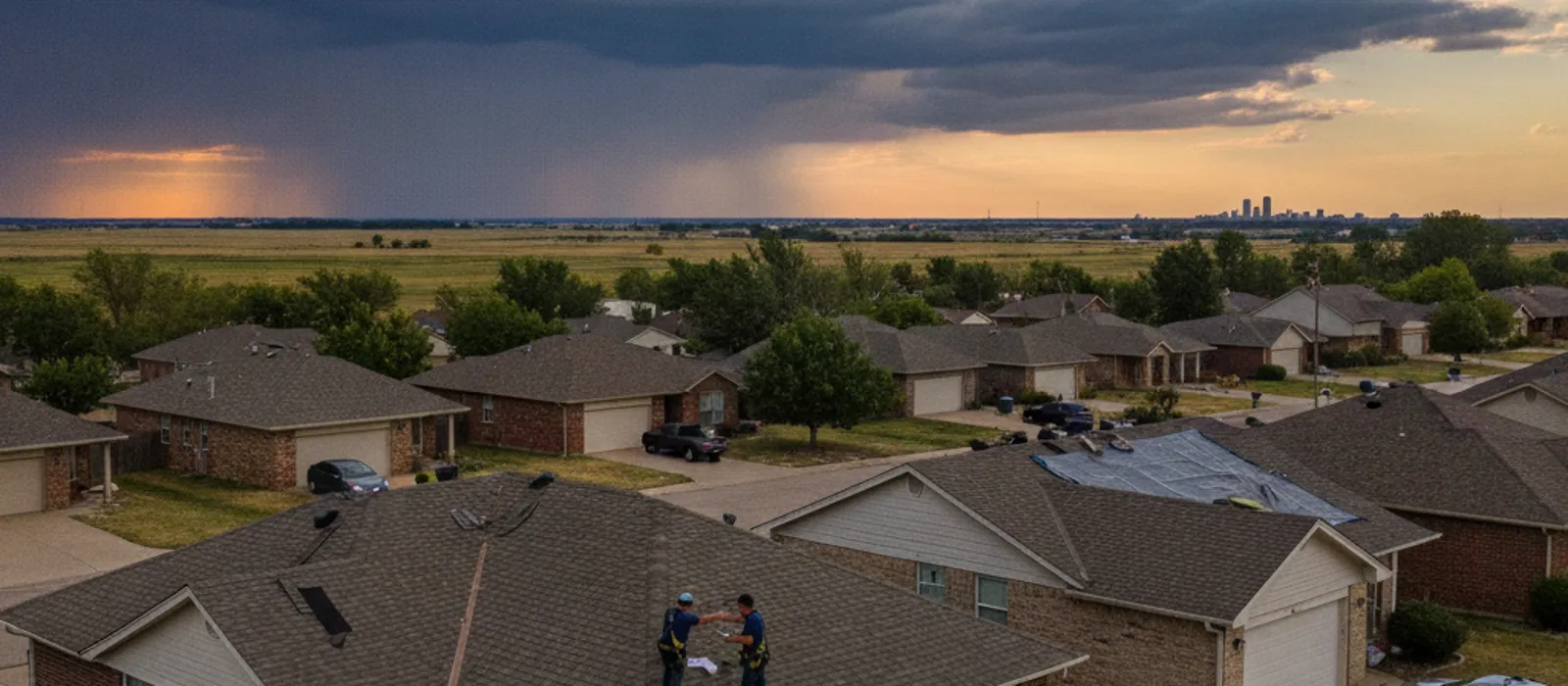
After a Wind Storm, Check Safety Before Roof Condition
Once conditions are safe, look from the ground for missing roofing, displaced metal, fallen debris, and new interior water signs. Arrange prompt professional help for an exposed opening, active leak, or material that could fall. A roof that appears intact from the driveway can still need evaluation, but a windy night alone does not establish damage or require replacement.
During a warning, stay sheltered instead of going outside to photograph the roof. The National Weather Service’s high-wind safety guidance advises sheltering in a sturdy building and avoiding downed power lines and falling debris.
For the inspection itself, use Wichita storm-damage roof repair or roof repair to request a condition-based assessment. Tell the contractor what changed and whether water is entering, so the visit can be prioritized appropriately.
Triage the Situation Before Collecting Photographs
The first distinction is between an immediate hazard and a routine inspection need. A loose sheet of metal over a doorway is different from a shingle fragment found in the yard. Keep people away from anything unstable and contact the appropriate professional or emergency service when there is an immediate danger.
If water is entering near electrical equipment, avoid the area and obtain qualified help. Do not stand beneath a bulging ceiling or attempt to puncture it. Roofing photographs can wait until people are safe.
For a limited stain without an immediate hazard, record its location and when you noticed it. If safely possible, move belongings away from the affected area. Do not enter a hazardous attic to chase the leak.
Explain urgency using observations: “water is dripping into the bedroom,” “roof material is hanging over the rear door,” or “a shingle piece is on the lawn.” Specific information helps the contractor distinguish emergency stabilization from a scheduled condition review.
Make a Ground-Level Observation Circuit
Walk only where the ground and surrounding area are safe. Use your phone’s zoom or binoculars from stable footing. Start with a wide photo of each visible elevation, then take closer views of areas that appear changed.
Look for gaps in the roof pattern, displaced ridge material, metal no longer aligned with the roof edge, or debris resting on the roof. Record where each observation appears. Do not try to determine the exact repair method from a distant image.
Check accessible interior rooms beneath the roof for new stains or dripping. Compare with older photographs where available. A preexisting stain should be identified as such rather than silently attributed to the latest weather.
Stay off ladders and the roof. Do not lift shingles to see whether they are sealed. An inspection request should lead to professional evaluation, not a homeowner experiment that could damage material or create a fall hazard.
Use This Inspection Request Checklist
| What you observe | How to describe it | What to request |
|---|---|---|
| A visible gap in shingles | Location and approximate extent from the ground | Prompt review of exposed area and adjoining roofing |
| Bent or hanging edge metal | Which elevation and whether people pass below | Safe access assessment and stabilization |
| New ceiling stain | Room, first noticed time, and whether it is growing | Leak-source investigation |
| Roof debris in the yard | Photograph of item and where it landed | Identification and roof check |
| Branch resting on roof | Location and visible surrounding hazards | Coordinated tree and roofing assessment |
| No visible change after severe weather | Known roof history and any concerns | Professional review when warranted, without assuming loss |
The checklist is intended to improve communication. It does not turn a homeowner into a damage assessor. A contractor should still inspect the actual materials and explain the limits of the inspection.
Keep a copy of the request with later findings. That makes it easier to see whether the inspection addressed the original concern or focused on a different issue.
Ask the Inspector to Describe Wind-Related Findings Precisely
Wind-related shingle concerns can include missing material, creases, tears, or changes at sealed areas. The report should describe the observed condition before discussing its likely cause.
GAF’s storm-damaged shingle bulletin notes that severe weather can leave surface cracks and weakened self-seal integrity. Such findings require interpretation in the context of the roof, not automatic attribution from one photograph.
Ask whether the affected shingles remain suitable for a manufacturer-compatible repair. The answer should consider the damaged material and the surrounding roofing that would be disturbed. A suggestion to apply adhesive everywhere is not a complete explanation of repairability.
If the contractor describes a seal issue, ask how it was evaluated and what installation guidance governs the proposed response. Do not perform a lift test yourself or encourage repeated manipulation merely to create dramatic photographs.
Give a Newly Installed Roof Its Installation Context
If wind concerns arise soon after replacement, give the inspector the installation date and exact product. GAF’s shingle warranty document explains that self-sealing shingles depend on suitable warm conditions to seal and that installation circumstances can affect sealing. This is a reason to review the actual installation, not to assume either a defect or harmlessness.
Ask the installer how the product instructions addressed the conditions during the project. Request the relevant photographs and any documented follow-up, particularly if the roof was completed during cooler weather. The inspection should distinguish the observed damage from the explanation offered for it.
Do not accept a blanket statement that a new roof cannot suffer wind damage. Equally, do not assume that a sealing concern proves every shingle needs replacement. Ask for a product-specific remedy tied to the documented condition.
Include More Than the Shingle Field
A useful wind inspection should address the locations relevant to the observed symptoms, including ridge caps, roof edges, vents, and flashing. Ask the contractor to identify which components were checked and which could not be accessed safely.
An exterior metal piece found in the yard may come from fascia, a gutter, or another part of the property. Have it identified before assuming it came from the roof covering. Keep the item only if it can be handled and stored safely.
Ask whether any displaced component has left an opening or affected drainage. A small-looking defect can require prompt work if it changes how water enters or leaves the assembly. Conversely, a visible bend may need a different response from an active leak.
The report should connect each finding to a proposed action. “Storm damage” as a single label does not tell you whether the work involves shingles, sheet metal, a vent, or several components.
Investigate Interior Water Without Guessing the Entry Point
A ceiling stain is evidence of moisture at that location, not a map of the exterior opening. PNNL’s roof valleys and penetrations guidance explains that water can travel along framing before becoming visible inside.
Tell the inspector whether the stain appears during wind-driven rain, after prolonged rain, or at another time. Describe the pattern without presenting it as a diagnosis. Photographs taken on different dates can show whether it is changing.
Ask what evidence links the proposed repair to the leak source. If the contractor cannot confirm the source during the first visit, request a next-step plan rather than accepting unrelated surface work as a guaranteed cure.
Interior drying or finish repairs may be separate from roofing. Confirm who handles those tasks and when it is appropriate to complete them. Repainting before the moisture source is addressed can conceal a useful indicator.
Preserve a Factual Storm Record
Write down the date and approximate time of the event and when you first noticed each condition. Preserve original photographs and invoices for any stabilization work. Keep a simple folder rather than scattering records across messages.
Weather reports can support the event timeline, but they do not prove the wind speed at a particular roof or the condition of its shingles. Avoid copying a nearby observation into the inspection report as a property measurement.
GAF’s storm-damage homeowner resources recommend professional evaluation after signs such as blown-off shingles. Use that as a prompt to investigate, not a substitute for the actual findings.
If neighbors discuss repairs, note the information only as context. Their roof age, material, orientation, and inspection results may differ. Your decision should remain tied to your property.
Understand What Inspection Methods Can and Cannot Show
Ground photographs can identify obvious changes but may miss small defects. A drone may improve overview coverage, while some details require closer professional examination. No single method answers every question.
Ask which methods were used and why. If the roof was not walked because of weather, pitch, or safety concerns, the report should say so. Limited access is a legitimate limitation when clearly disclosed.
Request both wide and close photographs. Wide views establish distribution; close views show the material condition. Without both, it can be difficult to tell whether several images represent separate defects or the same small area.
Do not require unsafe access to make the report seem more thorough. Ask instead what remains uncertain and whether a later visit, different equipment, or another specialist is needed to resolve it.
Separate Temporary Protection From Permanent Repair
Emergency stabilization has a narrower purpose than a finished repair. Ask what area will be protected, how the temporary measure will be documented, and what follow-up is required.
Have the contractor identify whether the temporary work will need removal before permanent repairs and whether that cost is included. Request photographs taken before and after stabilization when practical.
Do not climb onto the roof to install a tarp or secure loose material. A wind-damaged roof can present hazards beyond what is visible from the ground. The professional should determine safe access and the appropriate method.
If a larger replacement decision remains unresolved, ask how long the temporary measure is intended to remain and what event should trigger another review. Avoid treating temporary protection as an indefinite solution without a maintenance and follow-up plan.
Decide Whether the Findings Support Repair or Replacement
A limited defect may support a localized repair when surrounding material can be worked without creating a larger problem. Request a defined boundary and an explanation of how the repaired area will integrate with the roof.
Replacement becomes a more serious option when documented damage is widespread, the remaining material is poorly repairable, or multiple unresolved conditions make isolated work impractical. The report should explain which of those factors applies.
Do not use a universal number of missing shingles as the deciding rule. Location, product, surrounding condition, and associated damage matter. The same count can represent different repair scopes on different roofs.
When replacement is proposed, compare it through the Wichita replacement cost guide. Ask for a complete scope and any repair alternative the contractor considers reasonable, with the limitations of each stated plainly.
Keep Coverage Decisions With the Appropriate Party
A contractor can document physical findings and estimate work. Your insurer determines coverage under your policy. Those are related but separate responsibilities.
Provide accurate dates, photographs, and inspection documents if you pursue a claim. Avoid statements about causation that exceed what you know. A report can identify observations and professional opinions without making the homeowner claim certainty.
Ask the insurer directly about deadlines, requested documents, and any authorization needed before nonemergency work. Retain records of conversations. This article does not establish that wind damage is covered or that replacement will be approved.
Likewise, a manufacturer’s warranty provision is not the same as insurance. If a possible product issue is raised, contact the manufacturer with the installation information and follow its process separately.
Two Hypothetical Inspection Outcomes
In one hypothetical situation, a homeowner finds a shingle fragment after wind. The inspection identifies a small affected area and confirms that surrounding roofing can support a defined repair. The written scope names the location, replacement material, and associated detail work.
In another, the first visible clue is a similar fragment, but the inspection documents damage across several slopes and explains why disturbing adjoining material would prevent a reliable localized repair. The homeowner requests replacement options and a clear record of the findings.
These examples illustrate the importance of distribution and repairability. They are not case studies, predictions, or insurance outcomes. The initial ground observation is similar; the professional evidence changes the decision.
A third possible outcome is no documented roof defect, with the fragment traced to another structure. A useful inspection can provide reassurance without producing a repair sale. Keep the baseline photos for future comparison.
Close the Inspection With a Clear Action List
Before the contractor leaves, ask which conditions need attention now, which can be scheduled, and which only require observation. Each action should have a location and a reason.
If work is approved, retain before-and-after photographs and a final scope. If no work is recommended, retain the inspection report and its limitations. Both outcomes create a better record for the next weather event.
Ask what symptoms should prompt another call, particularly if the original concern involved water. New dripping, expanding stains, or newly displaced material should be reported with dates and photographs from safe locations.
An effective wind inspection ends with evidence and a proportionate response. The homeowner should understand what changed, what was actually found, and why the next step fits the condition of this roof.