
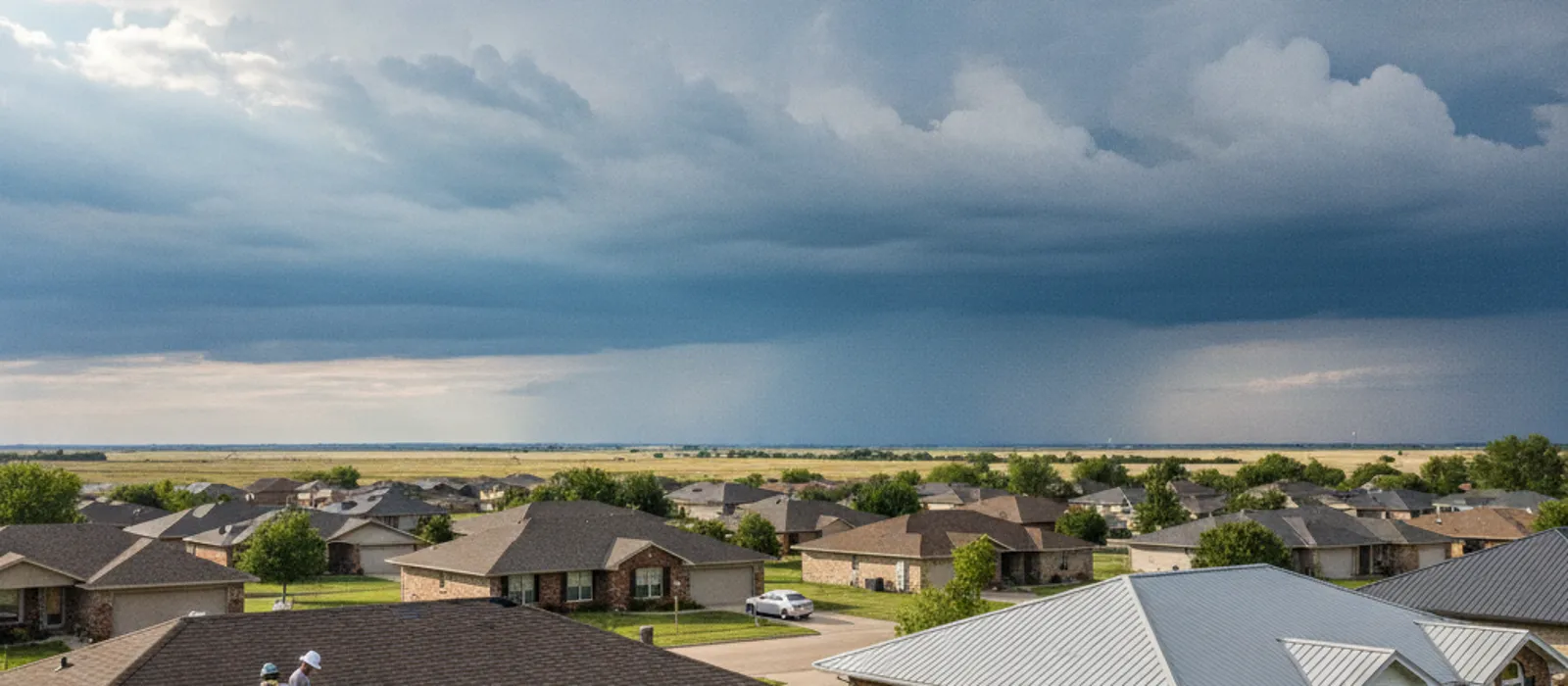
Ask About the Policy Before Assuming Hail Means a Paid Roof
After hail in Kansas, the useful insurance questions are specific: what damage has been documented, which policy terms apply to that damage, what deductible applies, and how will the insurer calculate and issue any payment? A roofer can describe roof conditions and propose work. The insurer determines coverage under the policy. Neither a neighborhood storm report nor a contractor’s replacement recommendation guarantees payment.
Start by locating the declarations page, full policy, roof-related endorsements, and any prior claim documents. Request an inspection for suspected damage through the hail damage roof repair page. Ask for findings that distinguish observed damage, possible cause, and proposed repair. That separation makes the insurance conversation more productive than sending a replacement price without explaining why the work is needed.
This guide is a set of questions for organizing that conversation, not a determination of your coverage. Policies and loss circumstances differ. Put important answers in writing, especially where a payment condition, deadline, exclusion, or deductible affects whether you can authorize construction.
Build a Question Sheet for the First Conversation
Use the table as a working document. Record the representative’s answer and the policy page or written claim explanation supporting it. An unanswered item is a follow-up task, not permission to assume the most favorable interpretation.
| Topic | Question to ask | Record to request |
|---|---|---|
| Reported event | What date and cause are recorded for this claim? | Claim acknowledgment |
| Roof coverage | Which roof endorsement applies to this loss? | Endorsement name and form |
| Deductible | Is the applicable amount fixed or calculated? | Written calculation |
| Valuation | How is the roof loss being valued? | Settlement explanation |
| Depreciation | Is any deduction recoverable, and under what conditions? | Conditions and submission deadline |
| Repair scope | Which slopes and components are included? | Itemized estimate and diagram |
| Additional work | How should newly discovered damage be submitted? | Supplement instructions |
| Completion | What proof is needed after the work? | Document checklist |
Ask one question at a time when an explanation becomes confusing. A representative can often clarify a line item more easily than respond to a broad request to explain the entire claim. Read back your understanding and ask for correction. Save the date, name, and promised next action.
Distinguish Roof Condition From Covered Cause
An inspection may identify deteriorated shingles, damaged flashing, and impact marks on metal accessories. Those findings do not necessarily share the same cause or date. Ask the inspector to describe the evidence for each conclusion rather than label every defect hail damage.
If a report mentions old repairs, request their locations and relevance. A prior repair may simply help orient a photograph, or it may indicate an earlier water-entry problem. Do not remove that history from the information you provide. A complete timeline is more useful than a simplified story that later conflicts with invoices or photographs.
Similarly, ask the insurer which observed conditions it accepts as part of the reported event and which it treats differently. If an item is excluded from the estimate, find out whether the issue is cause, coverage, measurement, repair method, or missing information. Each needs a different response.
For example, a measurement disagreement might be resolved with a roof diagram. A cause disagreement may need better inspection evidence. A policy interpretation question requires the relevant policy language. Sending the same estimate repeatedly does not answer all three issues.
Understand Valuation Without Treating It as a Promise
Actual cash value and replacement cost describe different valuation approaches. The NAIC explains that actual cash value accounts for depreciation, while replacement cost generally concerns replacing damaged property with comparable new materials, subject to the policy and deductible. NAIC roof valuation explanation.
Ask which approach applies specifically to the roof. Do not rely on the name of the overall homeowners package or a general statement made when the policy was purchased. Request the document that controls the roof settlement and ask whether any schedule or endorsement modifies it.
Then distinguish the total estimate from money available now. The estimate may show several amounts serving different purposes. Ask the representative to mark which figure is the approved scope value, which is the current payment, which is a deduction, and which might become payable after a condition is met.
Avoid signing a construction agreement based on adding every number on the estimate together. Some lines are intermediate calculations, not additional payments. A one-page explanation showing the flow from estimate to current payment can prevent a substantial budgeting error.
Work Through the Deductible in Actual Dollars
Ask the insurer to calculate the applicable deductible for this claim, even if the declarations page looks straightforward. If it is percentage-based, ask what amount the percentage uses. Do not assume that the percentage applies to the contractor’s price.
As a purely hypothetical arithmetic example, a two percent calculation applied to a stated base of $300,000 equals $6,000. The same percentage applied to a $15,000 repair price equals $300. This example is not a Kansas policy rule or a quoted roof price; it illustrates why the calculation base must be confirmed.
Once the deductible is known, keep it separate from optional upgrades and work the insurer has not agreed to include. Your budget should distinguish these items so a change to one does not obscure the others. Ask the roofer for a contract total independent of assumptions about claim proceeds.
Be wary of the phrase free roof. It does not explain the deductible, exclusions, valuation, or your obligations under the construction agreement. Ask for a written breakdown of who pays each part. Do not submit an invoice that misrepresents what was charged or paid.
Clarify Depreciation and Completion Conditions
If the estimate lists depreciation, ask whether the deduction can be recovered under your policy and what must occur first. Request the exact deadline, required evidence, and any limit tied to actual completed work. Do not assume that a figure labeled recoverable will arrive automatically.
Plan the construction payment schedule around confirmed funds and obligations. A contractor may require payment before a possible later insurance payment arrives. That timing difference matters even when the total numbers appear sufficient. Discuss the schedule before signing, not when the final invoice is due.
Ask how partial completion is handled if the claim includes roofing, gutters, and interior work performed by different contractors. Determine whether each portion requires separate evidence and whether the insurer needs invoices, photographs, or another inspection. Keep each trade’s documents identifiable.
If you choose a different material or narrower scope, ask the insurer how that decision affects settlement before proceeding. The purpose is not to seek a preferred answer; it is to understand the financial consequence while you still have choices.
Handle Temporary Protection and Permanent Work Differently
A roof opening or active leak needs prompt attention. Tell the insurer what temporary measures are necessary and ask how to preserve evidence. The Kansas claims checklist recommends retaining records of temporary repairs and discussing settlement details with the insurer. Kansas homeowners claims settlement checklist.
Ask the roofing contractor to identify emergency work separately from the permanent proposal. A temporary cover, return visit, and final repair can otherwise become difficult to reconcile. Before-and-after photographs should make clear what the emergency crew changed.
Do not leave an unsafe condition unaddressed merely because an inspection has not happened. Explain the urgency to the insurer and the professionals responding. Ask how removed materials should be documented when immediate work is necessary. Safety and evidence preservation should be coordinated rather than treated as competing all-or-nothing choices.
For permanent construction, seek a clear understanding of the accepted scope and unresolved items. An inspection appointment is not the same as approval of a replacement contract. A contractor’s willingness to start also does not answer the insurer’s coverage questions.
Compare the Estimate by Component
Lay the contractor’s proposal beside the insurance estimate and compare physical work. Start with roof area and affected slopes, then removal, underlayment, flashing, vents, disposal, and any decking allowance. Make a list of differences using the terminology in both documents.
The point is not that either estimate must automatically match the other. One may include optional upgrades; another may omit an item because supporting information has not been provided. Ask for a written explanation of each meaningful discrepancy before focusing on the overall dollar gap.
Use roof replacement cost planning to understand construction categories, while keeping policy questions with the insurer. If the roof only needs localized work, the roof repair service page is a more relevant starting point than a whole-roof material comparison.
Request a revised proposal when the agreed scope changes. Handwritten totals and scattered text messages can leave uncertainty about which version governs. Label the final documents by date and retain earlier versions so the sequence remains understandable.
Ask How Newly Discovered Conditions Will Be Reviewed
Some conditions are concealed until roofing is removed. Before work starts, ask the contractor how discoveries will be photographed and priced, and ask the insurer how additional documentation should be submitted. These are separate approval paths.
A contractor’s change order establishes proposed construction work. It does not establish insurance acceptance. Conversely, an insurer’s request for more documentation does not tell the crew how to leave an opened roof protected. Establish a communication plan for that situation in advance.
Ask who can approve a change when you are unavailable and whether there is a maximum preauthorized amount. A reasonable arrangement should let necessary decisions happen without giving unlimited authority. Photographs should identify the location and explain why the added work is needed.
For a hypothetical example, removal might expose a deteriorated deck area near an old leak. The homeowner would need a construction decision about restoring a sound base and a separate insurance answer about whether that condition belongs to the covered loss. Neither answer should be invented to make the schedule easier.
Resolve Disagreements With a Precise Record
The Kansas Department of Insurance advises contacting the insurer when you disagree with an estimate and explaining your reasoning. Its consumer guidance also discusses obtaining your own estimate. Kansas home claim guidance.
A useful reconsideration request names the disputed item, explains the difference, and attaches relevant evidence. For example, identify an omitted roof plane on the diagram or a flashing detail shown in a labeled photograph. Ask what additional information would allow review.
Keep emotional conclusions out of the evidence summary. You can be firm about needing an answer without accusing someone of motives you cannot establish. A short chronology and a specific requested response make the issue easier for another reviewer to understand.
If the problem remains unresolved, the department provides a consumer complaint process. Use its instructions and submit the supporting documents requested; a complaint is a route for assistance, not a promise of a particular settlement. Kansas insurance complaint process.
Keep a Calendar of Answers Still Needed
Create a calendar entry for every date the insurer gives you and every appointment the contractor schedules. Record the source of the date beside it. A policy deadline, a requested document date, an estimate expiration, and a crew reservation are different commitments, even when they fall in the same week.
If a delay threatens one of those dates, contact the responsible party before it passes and request written instructions. Do not assume a weather delay automatically changes an insurance requirement, or that a claim review automatically extends a contractor’s material price. Ask each party about the part it controls.
At the end of each call, identify the next action and its owner. That simple habit prevents a common coordination problem: the homeowner believes the contractor sent photographs, the contractor believes the homeowner submitted them, and the insurer is still waiting. A confirmation of receipt is more useful than an assumption that an email attachment arrived.
Finish With a Claim and Construction Reconciliation
Before treating the project as financially complete, reconcile the contractor’s final invoice, change orders, payments made, insurance payments received, and any outstanding submission. Separate an amount expected from an amount actually received.
Ask for written confirmation of remaining claim tasks. If the insurer needs a final invoice or completion photographs, submit them through the designated channel and retain confirmation. If a mortgage holder is involved in a payment, ask that institution about its own release process rather than assuming the roofer or insurer controls it.
Keep a concise roof record for the next owner or future inspection: product installed, installation date, photographs, permit documents where applicable, and paid invoices. Avoid describing the claim result as a general rule for future storms. A later loss may involve different circumstances or policy terms.
The most useful outcome is a documented decision: what work was necessary, what was contracted, what the insurer agreed to pay, and what remained your responsibility. That record lets you manage the project without relying on verbal promises about coverage or confusing a roof recommendation with a claim determination.
Frequently Asked Questions
Can the roofer explain my insurance estimate?
A roofer can help compare the listed construction work with its proposal. Direct questions about policy interpretation, payment conditions, and coverage to the insurer. If a contractor identifies an omitted component, ask for the supporting construction explanation and send it through the insurer’s review process. Keep that explanation separate from a promise that the item will be paid.
Should I sign before all scope differences are resolved?
First understand which differences remain and what financial obligation the contract creates. An unresolved optional upgrade is different from a large disagreement about necessary work. Ask for a revised scope or a clear written treatment of the uncertainty before committing.
What if I cannot find the old roof invoice?
Tell the insurer and inspector what records you do have and label the installation date as uncertain. Closing documents, earlier photographs, or previous inspection reports may help establish context. Do not invent a precise age to complete a form; ask how the unknown information should be recorded.